Follow these instructions to keep your seedlings in good condition and get your forest off to a good start. However, if you would like to get advice for planting, don’t hesitate to contact your personal forest specialist. You can also order planting work from your forest specialist if you do not have time to handle it yourself.

How to successfully plant a new forest
If you are a self-reliant forest owner, you can plant a new forest on your own – a planting tube and basket are all you need. No prior experience is required.
-
1
Check the quality of seedlings.
When you receive the seedlings you have ordered, open a few randomly picked boxes and check the quality of your seedlings before planting.
The seedlings must be healthy and viable, and free from defects. However, if defective seedlings account for more than five per cent of the content, contact your forest specialist without delay. Complaints about seedlings must be made within one week of the plants’ delivery.
-
2
Store the seedlings properly before planting.
If you have ordered frozen seedlings that arrive in boxes, thaw them in a shaded place.
Ensure ventilation by opening the carrying handles of the boxes or by rolling the seedling bag open down to the top of the root plug.
-
3
If the seedlings have thawed when they arrive, open the boxes immediately and water the seedlings during storage if necessary.
Plant them as soon as possible.
Properly stored and watered seedlings remain in good condition for 2–3 weeks.
-
4
Thawing usually takes three to five days. It's then time to plant the seedlings.
It's then time to plant the seedlings.
If you do not plant the seedlings immediately, open the boxes, monitor the moisture of the seedlings and water them if necessary.
-
5
Check that the seedlings start to grow.
The seedling stand should be inspected the following spring after the snow has melted to make sure that the new forest has got off to a good start and survived the winter.
When you visit the seedling stand, inspect the planted seedlings and visually assess their condition, and measure their density on sample plots.
To measure the sample plot:
- Holding a four-metre rod, turn around in a full circle and count the viable seedlings inside the circle that are at least one metre apart from each other.
- Multiply the number of seedlings by 200 to get the number of seedlings per hectare.
- If there are fewer than 1,500 seedlings per hectare in a pine stand, fewer than 1,300 in a spruce stand or fewer than 1,100 in a silver birch stand, we recommend replanting without delay.
- You can order just the seedlings for supplementary planting, or the planting work as well.
-
6
The development of the young stand should be monitored regularly.
On more fertile sites, it may be necessary to control ground vegetation by clearing it around the seedlings during the first few years.
The first seedling stand management measure is early clearing, which is usually carried out 4–6 years after planting, when the pine or spruce seedlings are about a metre tall, and deciduous trees begin to hinder their growth.
Plant the seedling in the centre of the mound
Proper soil preparation lays the foundation for successful forest cultivation and seedling stand development. However, soil preparation is useless if planting is done incorrectly.
- Before planting, make sure that the seedlings are thawed, and that the root plug releases a little water when gently squeezed. Water the seedlings if required.
- Plant the seedlings in unfrozen prepared soil.
- The best planting spot is in the centre of the mound, or in the absence of a mound, at the highest spot in mineral soil. A seedling that is planted adequately deep in the centre of the mound roots and grows well. Avoid planting in unprepared soil.
Inverting is the most common soil preparation method used by Metsä Group. The following picture shows the correct planting spot on an inverted mound.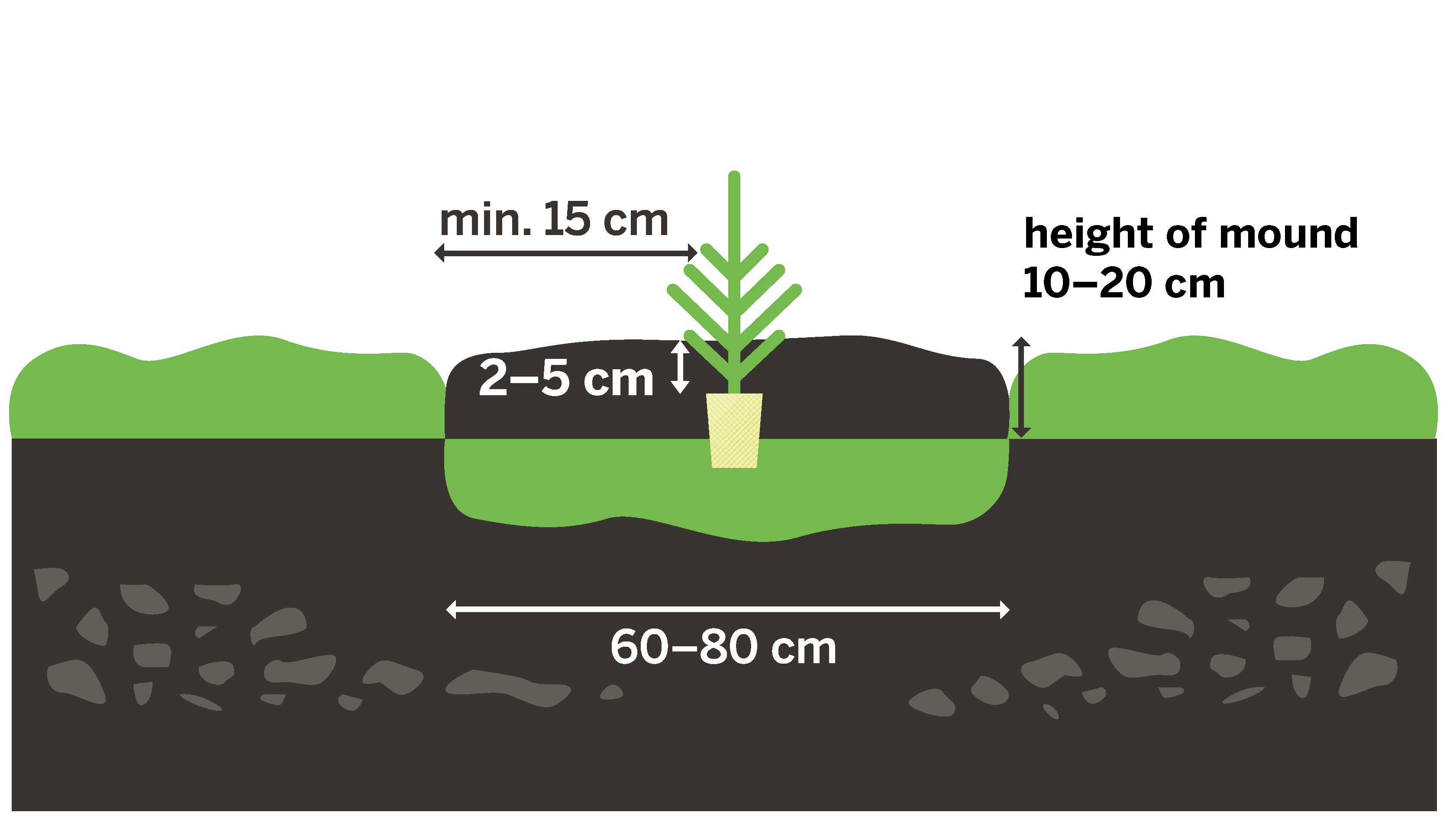
Be mindful of safety and the environment
The seedlings have been treated against pine weevils, and this may irritate the skin. To avoid skin symptoms, use nitrile gloves when handling and planting seedlings. Wash your hands after working with seedlings. Please note that planting tools must never be rinsed off in natural waters. Do not leave empty seedling boxes in the forest. They can be disposed of as mixed or energy waste.
Logo license of Metsäliitto Cooperative's FSC® group certification: FSC-C111942